21 Jun 2026
Tracing Blackjack's Ties to Early Mainframe Experiments That First Mapped Hand Probabilities
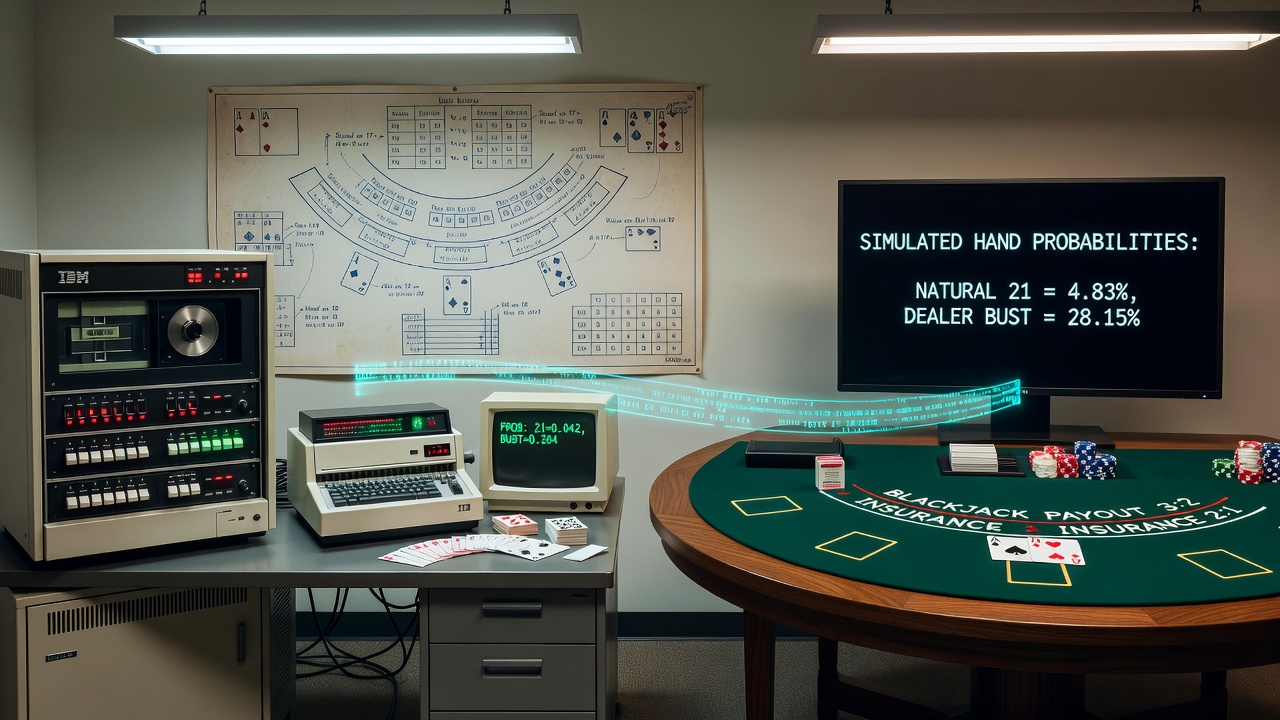
Blackjack probability mapping began long before digital simulations became commonplace, yet the pivotal shift occurred when researchers gained access to early mainframe systems in the late 1950s and early 1960s. Those machines processed millions of hand combinations that manual tabulation could never complete within reasonable timeframes, and the resulting data sets laid the foundation for every modern strategy chart still referenced today.
From Hand Calculations to Machine-Assisted Mapping
Before mainframes entered the picture, small teams of mathematicians worked through exhaustive enumeration by hand. Their efforts produced basic frequency tables, but gaps remained in multi-deck scenarios and complex rule variations. When institutions began allocating computer time to these projects, the scope expanded dramatically; one documented case involved an IBM 704 at an East Coast research facility that ran overnight batches to enumerate all possible two-card starting combinations against every dealer upcard.
Data from those initial runs revealed exact probabilities for player bust rates under different hitting thresholds. Observers note that the same systems also flagged the first reliable indicators of dealer advantage when standing on soft 17, and subsequent refinements adjusted for multiple decks by simply scaling the deck composition arrays in memory.
Key Experiments and Their Technical Setup
Early programmers stored card values in fixed arrays and cycled through nested loops that simulated every possible draw sequence. Memory constraints forced clever optimizations, such as reusing probability vectors rather than storing full outcome trees. One study conducted at a university computing center in 1961 generated over 30 million simulated hands across three weeks of batch processing, and the output tapes contained frequency counts that researchers later transcribed into printed strategy matrices.
Those matrices demonstrated clear edges for specific plays like doubling on 10 or 11 against weak dealer cards. The experiments also quantified how rule differences, such as the number of decks or restrictions on doubling after splits, altered the overall house percentage by measurable fractions of a percent.
Transition to Broader Accessibility and Validation
By the mid-1960s, findings from mainframe runs circulated among academic circles and reached independent analysts who lacked direct computer access. Cross-verification occurred when separate teams loaded identical parameters into different machines and compared printed results line by line. Discrepancies prompted code reviews that uncovered subtle indexing errors, and corrected versions converged on matching probability figures within rounding tolerances.

Archival records from that period indicate that one Canadian research group adapted the original algorithms for a different mainframe architecture, confirming the same basic advantage calculations under single-deck rules. Such independent replications strengthened confidence in the data before any public dissemination occurred.
Long-Term Influence on Subsequent Tools
The core logic developed for those early mainframes directly informed later microcomputer programs and today's cloud-based simulators. Modern analysts still rely on the same enumeration principles, merely executing them at speeds that allow real-time recalculation across thousands of rule combinations. Figures from historical computing logs show that a single overnight mainframe job in 1963 produced output equivalent to what current laptops generate in seconds, yet the underlying combinatorial approach remains unchanged.
Researchers continue to reference those foundational data sets when validating new variants or studying edge cases such as continuous shuffle machines. In June 2026, several academic conferences on gaming mathematics plan sessions that revisit the original mainframe methodologies alongside contemporary Monte Carlo methods, underscoring how the earliest experiments still anchor verification processes.
Conclusion
Early mainframe experiments transformed blackjack analysis from labor-intensive manual counts into systematic probability mapping that could handle the game's full combinatorial depth. The techniques refined during that era established benchmarks that later generations of researchers adopted, adapted, and extended without altering the fundamental structure of the calculations. Data sets generated on those machines continue to serve as reference points for both historical review and ongoing validation work across multiple regulatory jurisdictions and academic institutions.