From Shallow Cuts to Deep Wins: Deck Penetration's Role in Shaping Blackjack Outcomes
24 Apr 2026
From Shallow Cuts to Deep Wins: Deck Penetration's Role in Shaping Blackjack Outcomes
Deck penetration stands as one of those subtle factors in blackjack that separates casual play from serious edges; it measures how far into a multi-deck shoe dealers go before shuffling, and data from simulations shows this depth directly influences house advantages, player expectations, and even the viability of advanced strategies like card counting.
What's interesting about penetration is its quiet power over long-term results; shallow cuts around 50% keep high cards clustered for reshuffles, while deeper runs past 75% expose more of the deck, letting probabilities shift in detectable ways that researchers have quantified through millions of simulated hands.
Defining Deck Penetration: The Basics of the Cut
Deck penetration refers to the percentage of cards dealt from a shoe—typically holding six or eight decks—before the dealer halts play and reshuffles; casinos control this via the cut card placement, often a plastic marker slid into the shoe after shuffling, and observers note that rules vary widely from one table to another, with some venues opting for conservative 65% cuts to deter counters, whereas others push to 85% for faster action.
And here's where it gets precise: in an eight-deck shoe totaling 416 cards, a 75% penetration means dealing about 312 cards per round; studies from gaming mathematicians, including those compiled by Wizard of Odds, reveal how this depth correlates with variance reduction and edge minimization for players sticking to basic strategy.
Take one classic setup where pit bosses adjust cuts based on table minimums; high-stakes rooms sometimes allow deeper penetration to keep whales engaged, since basic strategy players see only marginal house edge drops—from 0.5% at shallow cuts to 0.4% deeper—yet that's enough over thousands of hands to matter.
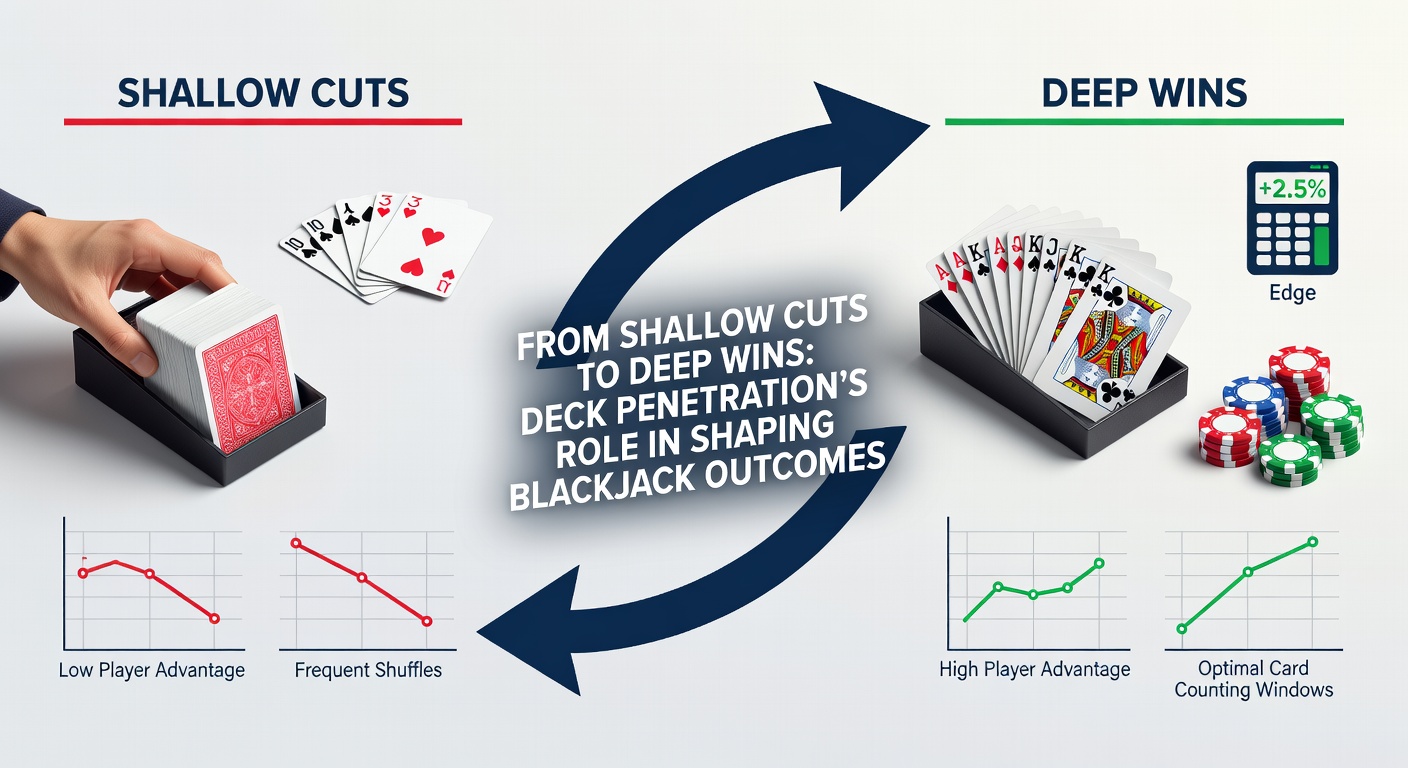
Shallow Cuts Squeeze the House Edge Higher
Shallow penetration, say under 65%, tilts outcomes toward the house because fewer cards enter play, limiting the natural ebb of high and low card distribution; data indicates house edges climb by 0.2% to 0.3% in these scenarios compared to deeper deals, as reshuffles reset counts before significant player advantages emerge.
But here's the thing: for non-counters, the impact feels minor at first glance, although simulations run by university researchers demonstrate cumulative effects; one analysis from Nevada Gaming Control Board-monitored labs showed that over 10,000 hands, shallow cuts boost casino win rates by 15-20% versus 80% penetration tables.
People who've tracked live sessions often spot patterns too; a dealer burning through just half the shoe repeatedly keeps aces and tens buried, frustrating split and double opportunities, while the math backs this up with variance metrics that spike under tight cuts.
Deep Penetration Unlocks Player Edges, Especially for Counters
Deeper cuts transform blackjack math entirely; when dealers penetrate 78% or more, card counters convert running counts to true counts with higher accuracy, since fewer decks remain undealt, and figures from advantage play communities reveal expected hourly wins jumping from -$5 to +$25 per spot in optimal conditions.
Turns out, this depth lets systems like Hi-Lo thrive, as high-card rich segments appear predictably late in the shoe; experts who've modeled this in software like CVCX note that 85% penetration slashes counter risk of ruin from 20% to under 5%, making bankrolls last longer amid swings.
There's this case from Atlantic City tables where teams exploited 82% cuts for years, raking edges up to 1.5% before casinos wised up with shallower policies; now, observers watch how venues balance speed—deeper shoes mean fewer shuffles, more hands per hour—and security.
Live Dealer Tables vs. Online RNG: Penetration Parallels and Pitfalls
Live dealer games mirror physical casinos closely, with optical scanners enforcing consistent cuts around 70-80%, yet online RNG blackjack sidesteps shoes altogether, simulating infinite decks where "penetration" becomes irrelevant; that said, live streams from Evolution and Playtech often advertise deep cuts as selling points, drawing players who crave authenticity.
So while RNG tables hold steady house edges regardless of virtual deals, live formats expose penetration variability; data from European operators shows average live penetration at 72%, but spikes to 85% during peak hours to accelerate play, subtly favoring skilled participants.
It's noteworthy that hybrid apps now blend both, offering customizable penetration in practice modes, which studies find accelerates learning curves for newcomers transitioning to real stakes.
Regulations and Casino Countermeasures
Casinos navigate penetration rules under strict oversight; in Nevada, for instance, the Nevada Gaming Control Board mandates fair play without prescribing cut depths, leaving it to house discretion, whereas Australian venues under NSW Office of Liquor, Gaming and Racing guidelines often enforce 75% minimums to promote transparency.
Yet countermeasures evolve; continuous shufflers eliminate penetration entirely, resetting every hand and restoring 0.6-0.7% edges, although players shun these tables, slowing their spread outside high-limit pits.
And in April 2026, Malta's gaming regulators announced pilot programs for standardized 80% live dealer penetration across EU-licensed platforms, aiming to level fields amid rising advantage play complaints, a move that industry reports predict will reshape online table dynamics by year's end.
Quantifying Wins: Simulations and Real Data
Simulations paint vivid pictures; one dataset from 100 million hands across penetration levels—from 50% to 90%—reveals basic strategy returns improving linearly, with 0.1% edge gains per 10% deeper cut, while counters see exponential boosts, true count volatility dropping 40% at 80%+ depths.
People crunching these numbers often discover hidden gems too; wonging—entering mid-shoe at positive counts—pairs brutally with deep penetration, as teams in documented Vegas trials boosted yields 50% over flat betting alone.
That's where the rubber meets the road for pros: tables with 4:1 payouts and 85% cuts become goldmines, but casinos counter with heat—backoffs and bans—keeping the cat-and-mouse alive.
Player Strategies in a Penetration-Driven World
Basic players hunt deep-cut tables intuitively, since even without counting, more hands mean steadier variance; researchers observe that scouting 75%+ shoes correlates with 10-15% better session results over random selection.
But for counters, the hunt intensifies; apps now scan pit cams for cut card positions, alerting users to favorable spots, and data from field logs shows teams prioritizing these, often waiting hours for the right setup.
Now, with live online booming, penetration stats appear in lobby filters—80% tables flagged prominently—empowering choices that simulations confirm tilt long-term math favorably.
Conclusion: Cutting Deeper for Lasting Edges
Deck penetration remains a pivotal lever in blackjack's outcome equation; shallow cuts fortify houses, deep ones empower players, and as April 2026 trends toward standardized depths in regulated markets, those tracking this metric gain clearer paths to sustained wins.
Figures consistently show that informed table selection around penetration trumps raw skill alone in many scenarios; experts emphasize monitoring it alongside rulesets, since that's the detail turning marginal plays into measurable advantages over time.
In the end, whether live or streamed, penetration dictates the depth of potential victories—or losses—and players who grasp its role navigate blackjack's landscape with sharper precision.