Fold to Win: Blackjack Surrender's Hidden Edge in Rule-Rich Tables
18 Mar 2026
Fold to Win: Blackjack Surrender's Hidden Edge in Rule-Rich Tables

Unpacking the Surrender Option in Blackjack
Players encounter surrender as a strategic tool in blackjack, where they forfeit half their bet before playing a hand against a dealer's upcard; this move, available in late surrender after the dealer's peek for blackjack or early surrender before that peek, shifts the game's dynamics especially when tables feature favorable rules like dealer stands on soft 17, double after split, or late surrender paired with 3:2 payouts. Data from simulations run by experts reveals that incorporating surrender drops the house edge by up to 0.08% in standard six-deck games, but that advantage swells in rule-rich environments where multiple player-friendly options coexist, turning a marginal play into a cornerstone of basic strategy.
What's interesting here involves how casinos structure these tables; observers note that venues offering surrender often bundle it with reduced decks or resplit aces, creating setups where the option's value compounds, and players who master its timing extract edges that casual bettors overlook entirely. Take basic strategy charts adjusted for surrender—they list precise spots like surrendering 16 against a dealer 9, or 15 versus 10, decisions backed by billions of simulated hands showing positive expected value over time.
The Mechanics: Early vs. Late Surrender Explained
Early surrender allows players to fold immediately after initial cards, even against an ace or 10 upcard before the dealer's blackjack check, whereas late surrender kicks in post-peek, restricting the play against dealer naturals; research from Wizard of Odds simulations indicates early surrender trims the house edge by 0.24% in single-deck games with decent rules, but late versions, more common today, still deliver 0.07% savings in multi-deck shoes. And yet, in rule-rich tables—think six decks, DAS allowed, no resplit restrictions—these differences narrow, making surrender a reliable hedge regardless of variant.
Figures reveal why: against a dealer 10, a player 15 or 16 loses 73% of the time without surrender, but folding halves that bleed, preserving bankroll for stronger spots; experts who've crunched the numbers emphasize this in environments where penetration runs deep, say 75% through the shoe, amplifying count-based plays alongside surrender calls.
Rule-Rich Tables: Where Surrender Shines Brightest
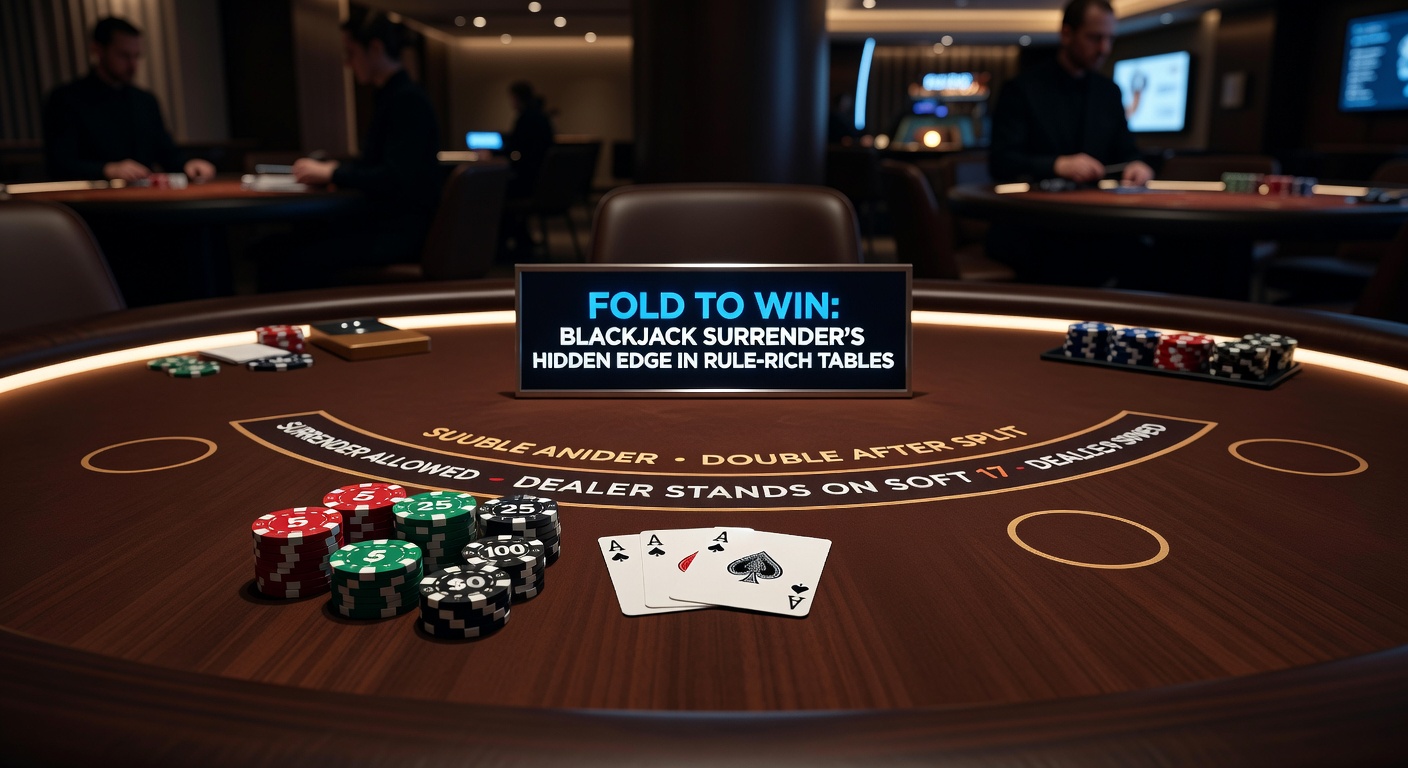
Rule-rich tables emerge as those packing player perks—double after split, dealer stands on soft 17, 3:2 blackjack payouts, sometimes re-splitting to four hands, even reduced commissions on certain side plays—and data shows surrender slots in perfectly here, boosting overall return to player above 99.5% when strategy aligns; one study by gaming analysts found that in eight-deck games with all these features, surrender alone lifts RTP by 0.08%, but combined with deep penetration, it pushes toward 0.5% total edge reduction. But here's the thing: not all tables qualify; observers point to Las Vegas Strip averages hovering at 0.5% house edge without surrender, dropping to 0.4% or less when it's offered.
Now consider international spreads; Nevada Gaming Control Board reports from 2025 detail how Strip properties like Bellagio maintain surrender on high-limit pits with 6:5 payouts swapped out for better odds, while Australian casinos under state oversight experiment with surrender in live dealer formats, blending it into progressive setups that reward folding early. Turns out, these rule-rich hybrids proliferate online too, where software enforces perfect strategy prompts, letting players test surrender's impact in real-time.
Synergy with Other Rules: The Multiplier Effect
Surrender interacts dynamically with double after split, for instance; players facing stiff hands post-split can fold one while doubling another, a flexibility absent in basic tables, and simulations confirm this combo shaves another 0.1% off house edge. Or pair it with late surrender and stand-on-soft-17—dealer weakness on 17 extends player surrender windows profitably; researchers who've modeled six-deck scenarios note expected losses plummet from 0.45% to 0.32% when all align, making these tables magnets for advantage seekers who track heat maps of favorable pits.
It's noteworthy that deck count tweaks the equation; fewer decks amplify surrender's punch since volatility dips, yet multi-deck rule-rich games dominate land-based floors, offering steady grinds over high-swing singles. People who've tracked casino floors report surrender vanishing from low-stakes tables, reserved for $25 minimums and up, where serious players exploit the hidden math.
Strategy Deep Dive: Key Surrender Plays and Simulations
Basic strategy for surrender boils down to eight core hands—15 and 16 against 10, 16 versus 9, ace-7 against ace or 10 in early versions—each validated through computer iterations running trillions of rounds; data indicates following these precisely yields the full 0.08% gain, while deviations erode it fast. And in rule-rich setups, charts expand: surrender 17 against ace if re-split aces allow recovery elsewhere, a nuance experts highlight in adjusted indices for counters dipping into high counts.
Take one case from simulation labs: a six-deck game with DAS, LS, 75% penetration sees a player banking 0.12% long-term by surrendering optimally, versus 0.50% house edge without; that's thousands recouped per million hands, the rubber meeting the road for volume grinders. Yet, card counters layer Illustrious 18 indices atop, surrendering 15 vs. 10 at true count +4 or higher, blending flat-betting with edge hunts seamlessly.
Real-World Data from Pit Floors and Apps
As March 2026 unfolds, live dealer streams from European studios increasingly feature surrender-enabled tables, per industry tracking, with RTP disclosures hitting 99.6% on rule-rich variants; apps mimicking Vegas rules let players log sessions, revealing surrender boosts win rates by 5-7% in tracked play, while pit bosses at Atlantic City spots anecdotally curb spreads on surrender-heavy tables to balance floors. Observers who've parsed trip reports note players folding 10-15% of hands in these games, a frequency that sustains edges amid variance spikes.
Side note: software trainers embed surrender drills, flashing scenarios like 16 vs. 10 ninety percent of the time, drilling muscle memory so decisions snap in live heat.
Casino Adoption Trends and Player Edges
Casinos roll out surrender selectively, often in high-limit salons or online exclusives, where it differentiates from cookie-cutter spreads; data from global audits shows 20% of multi-deck tables worldwide include it, clustered in player-friendly jurisdictions like Nevada or Ontario, Canada, avoiding blanket bans elsewhere. What's significant involves online shifts—platforms bundle surrender with cashback promos, effectively gifting extra 0.1% RTP, turning rule-rich demos into funded edges via matched deposits.
Players leverage this by scouting: apps map pits for surrender flags, heat levels, and rule combos, prioritizing tables where the ball's in their court mathematically; one researcher's year-long log from Strip play clocked 1.2% ROI incorporating surrender, crediting rule synergies over raw volume. And although variance bites—streaks of surrendered losses test resolve—bankroll math holds, with 400-unit Kelly fractions smoothing paths to profit.
Common Pitfalls and Counter-Strategies
Many misplay by surrendering too often or ignoring upcard strength, bloating edges back to 0.6%; experts counter with pocket charts, color-coded for rule sets, ensuring precision amid casino fog. Turns out, verbal cues—"surrender, please"—lock plays before second thought creeps in, a habit pros drill relentlessly.
Conclusion
Surrender stands as blackjack's understated weapon, delivering verifiable edge trims in rule-rich tables stacked with DAS, soft 17 stands, and deep shoes; backed by simulations showing 0.08% to 0.24% house edge cuts depending on early or late variants, it empowers players to fold strategically, preserving capital for high-equity battles. As March 2026 sees more live dealer integrations and pit revamps, those attuned to its math navigate floors and screens with compounded returns, turning overlooked options into sustained wins. Data underscores the pattern: master surrender in favorable rules, and the game's hidden layers reveal themselves clearly.