10 Jun 2026
Continuous Shufflers and Blackjack: Adjusting Basic Strategy for Machine-Intervened Decks
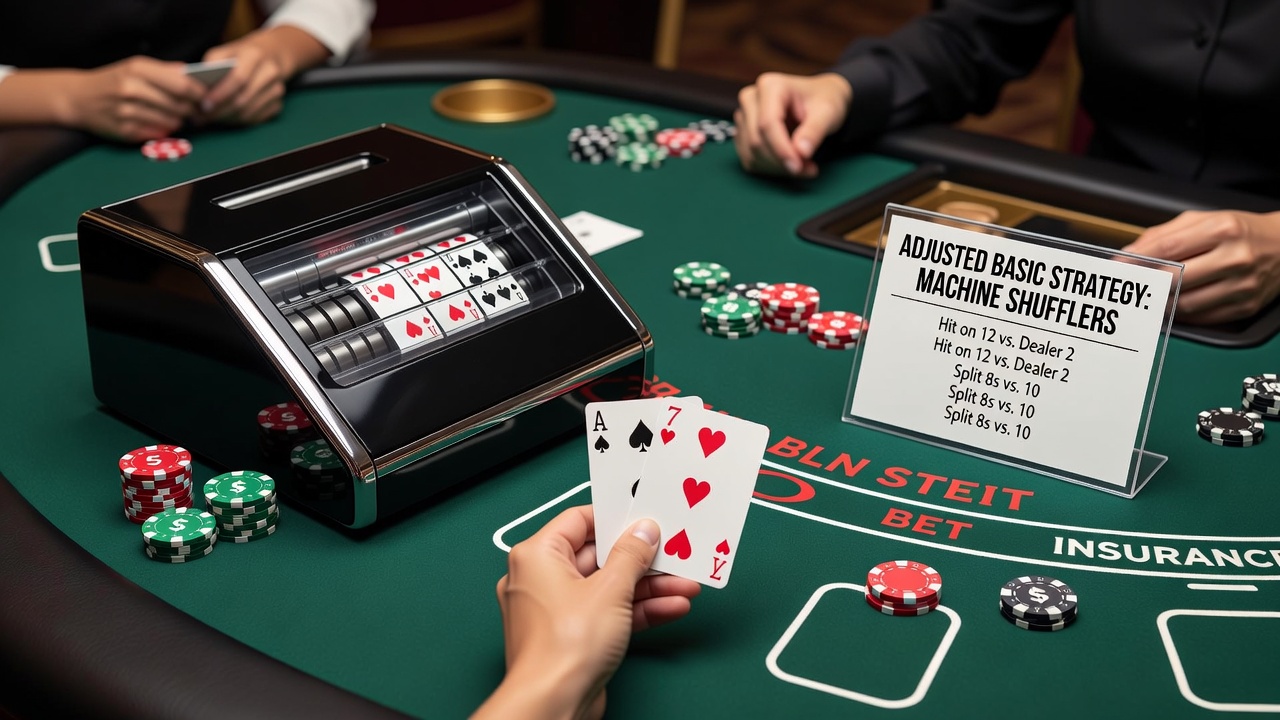
Continuous shufflers have become standard equipment in many casino environments because they automate the process of returning discarded cards to the active deck without halting play for manual reshuffles. These machines hold a pool of cards and feed them back into circulation at regular intervals, which keeps the shoe size relatively stable throughout each session.
How Continuous Shufflers Operate in Practice
Operators place a continuous shuffler beside or beneath the table, and the device draws from a reservoir that includes both used and unused cards. Every few hands the machine randomly reinserts a batch of previously played cards, which prevents the deck from depleting in the same linear fashion seen with traditional multi-deck shoes. Data from regulatory testing in Nevada shows that this intervention maintains an average penetration rate above 80 percent across extended periods of play.
Because cards re-enter the shoe almost immediately, the probability distribution of remaining cards stays closer to the initial composition for longer stretches. Researchers at the University of Nevada, Las Vegas documented this effect in controlled trials where continuous shufflers reduced variance in card frequencies by measurable margins compared with cut-card shoes.
Deck Composition Changes and Player Decisions
Basic strategy charts assume a fixed number of decks with known depletion patterns, yet continuous shufflers alter those patterns by reintroducing cards before natural exhaustion occurs. Players therefore encounter situations where the expected value of certain plays shifts slightly because the machine resets portions of the deck mid-round.
Studies compiled by the Alcohol and Gaming Commission of Ontario indicate that the overall house edge remains nearly identical to standard multi-deck games, yet specific hand matchups show deviations of less than 0.2 percent in some rule sets. These small changes arise when the machine mixes high or low cards back into play at rates that differ from passive shoe depletion.

Adjusting Basic Strategy Tables for Machine Intervention
Strategy adjustments focus on borderline decisions that become sensitive to the altered card-return frequency. For example, certain soft doubling and pair-splitting choices require recalibration when the machine frequently reintroduces ten-value cards. Observers note that players who rely on static charts without modification encounter these edge cases more often in continuous-shuffler environments.
One approach involves consulting updated indices that account for the machine's mixing interval, which several equipment manufacturers publish alongside their hardware specifications. According to figures released by the Nevada Gaming Control Board in early 2026, casinos that adopted revised basic strategy guidelines for continuous-shuffler tables reported consistent alignment between theoretical and actual hold percentages through the first half of the year.
Dealers follow standardized procedures that dictate when the machine activates, and these timing protocols influence the exact composition players face. Training materials distributed by gaming equipment suppliers outline the intervals at which cards typically return, giving players concrete data points for refining their decision trees.
Current Developments as of June 2026
By June 2026, several North American jurisdictions had expanded the use of continuous shufflers across higher-limit blackjack pits. Regulatory filings show that new installations incorporate enhanced random-number verification to maintain compliance with existing fairness standards. Industry reports from the same period document incremental updates to strategy reference cards that reflect the latest machine specifications.
These updates remain modest because the core mathematics of basic strategy stays intact for the majority of hands, yet the targeted refinements help minimize the cumulative effect of repeated small deviations over long sessions.
Conclusion
Continuous shufflers maintain stable deck sizes while changing the timing of card re-entry, which creates measurable but limited shifts in certain basic strategy decisions. Players who track these machine-specific frequencies can apply refined indices that align with documented return patterns. Regulatory data from multiple regions continues to confirm that overall game mathematics remain consistent when the correct adjustments are in place.